

AI-assisted development is rapidly reshaping how software is imagined and built. Tools such as Claude Code and emerging “vibe coding” approaches promise something that feels almost inevitable: applications generated from natural language prompts, with minimal traditional engineering effort. For developers and product teams, the appeal is obvious. The cycle from idea to prototype collapses. Delivery accelerates. Friction disappears.
Picture this. A developer on your platform engineering team is under pressure to deliver a new customer data API. The deadline is tight. Instead of working through the usual design and implementation cycle, they open Claude Code or a similar AI tool. They paste in the database schema to provide context. They describe the integration pattern. They ask the model to generate the service layer. Within seconds, the response is excellent. Clean code. Working logic. A meaningful acceleration in productivity.
From the developer’s perspective, nothing unusual has happened. From a security perspective, something significant has just occurred. A complete production database schema, table structures, relationships, naming conventions, and internal data architecture has now been transmitted outside the enterprise boundary to an external inference system. It was not logged by internal security systems. It will not appear in standard change management workflows. And in most organisations, it is happening repeatedly across engineering teams without formal visibility or risk assessment.
This is not a future scenario. It is the operational reality of AI-assisted software development in 2026. And it exposes a gap most enterprise governance frameworks were never designed to handle.
In enterprise environments, software is never just about speed. It is about accountability, governance, integration, and risk management. And this is where a more difficult question emerges, one that is often overlooked in the enthusiasm around AI coding tools. It is not whether AI can write software. It clearly can. The real question is where that AI operates, and what happens when it sits outside the enterprise boundary.
What “Vibe Coding” Actually Means
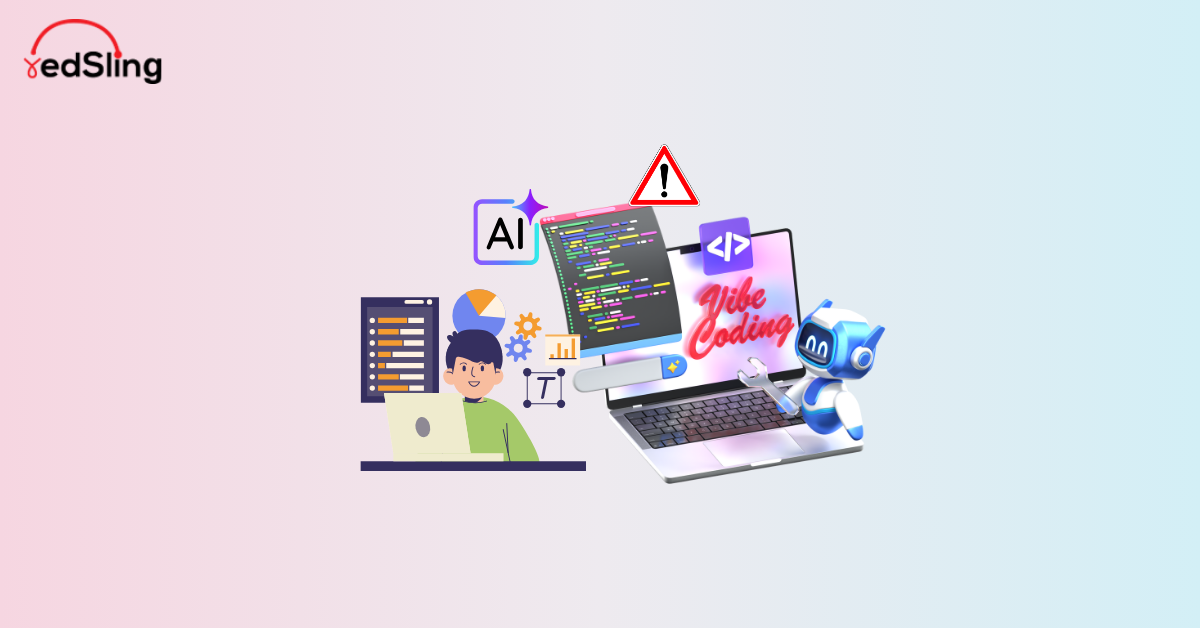
“Vibe coding” refers to a shift in software development where engineers describe intent in natural language, and AI systems generate functional code in response. The developer’s role evolves from implementation to orchestration, prompting, reviewing, and assembling AI-generated output.
Tools such as Claude Code, GitHub Copilot, Cursor, and similar platforms are accelerating this shift rapidly. In many environments, the cycle from idea to working prototype has collapsed from weeks to hours.
For startups and individual developers, this is transformative. But enterprise software is not prototype development. It operates under fundamentally different constraints such as security, governance, integration, auditability, compliance, and long-term operational accountability.
Which brings us back to the central question: It is not whether AI can write software. It clearly can. It is where that AI operates, and what happens when it sits outside the enterprise boundary.
When Productivity Becomes Data Exposure
Most external AI coding tools operate by transmitting code context, metadata, and system structures to remote inference endpoints. In enterprise environments, this is not just “code assistance,” it is often the unintentional exposure of the organisation’s internal architecture.
What gets shared is rarely limited to a single file. Developers may include database schemas, API structures, configuration files, integration endpoints, and naming conventions that reveal how systems are designed and connected. In practice, they are providing a compressed version of the enterprise architecture to an external system.
This is rarely malicious. It is operational convenience under pressure. The developer is solving a problem; the AI simply needs context. But once this information leaves the enterprise boundary, it is no longer governed, logged, or controlled by internal systems.
For regulated industries such as financial services, healthcare, defence, and government, this introduces immediate compliance tension. Data residency requirements across regions like the EU, Australia, and India may restrict where such information is processed. In many organisations, there is still no formal classification of whether AI prompts containing system context constitute regulated data transfers under GDPR-equivalent frameworks or internal governance policies.
What appears to be productivity is, in effect, an unmonitored expansion of the enterprise attack surface.
The Intellectual Property Problem Is More Complex Than It Looks
Alongside data exposure sits a more complex and less resolved issue: ownership.
When AI systems generate production-grade code, the traditional boundaries of intellectual property become less clear. Enterprises are left navigating questions that legal frameworks have not fully standardised. Who owns the output now, is it the organisation that prompted the system, the developer who initiated the request, or the model provider that generated the result? And do the terms of service governing these models introduce any downstream claims or usage rights that enterprises may not fully anticipate?
The issue becomes even more sensitive when proprietary algorithms, trade secrets, or competitive differentiators are included in prompts. In such cases, the act of generating code is no longer isolated within enterprise systems, it is partially occurring within external infrastructure that is outside organisational governance.
For many enterprises, especially those built on defensible intellectual property, this introduces a structural ambiguity that is difficult to reconcile with traditional IP protection frameworks.
Governance Systems Built for Humans, Not Machines
Enterprise governance frameworks assume a simple principle: humans write code, and humans are accountable for it. Regulatory systems such as SOX, HIPAA, and ISO standards depend on this assumption. They require traceable authorship, documented approvals, and auditable change histories tied to identifiable individuals.
AI-generated code breaks this model at a structural level. When significant portions of software are produced through prompts, authorship becomes distributed across developers, tools, and models. Security teams can no longer easily determine who is responsible for a specific implementation decision. Audit processes struggle to reconstruct intent. Compliance teams face difficulty mapping outputs back to formal approval chains.
This is not a missing feature in current tooling. It is a mismatch between governance systems designed for deterministic human workflows and software increasingly generated through probabilistic systems.
Integration Reality: Where AI Meets Enterprise Architecture
Even where organisations attempt adoption, AI coding tools quickly encounter integration and governance challenges. Enterprise environments are highly structured ecosystems comprising CI/CD pipelines, identity and access controls, source code repositories, security scanning platforms, cloud infrastructure, secrets management, data loss prevention layers, and compliance controls. In mature organisations, these systems are deeply interconnected and strictly governed, with a typical software delivery pipeline often involving forty or more integrated components.
Modern AI coding assistants can connect to repositories, issue trackers, CI/CD pipelines, cloud platforms, and enterprise knowledge sources. While these integrations unlock significant productivity gains, they also expand the risk surface. Organisations must understand what source code, intellectual property, business logic, and operational data are being shared, what systems AI agents can access, what actions they can perform, and how credentials, secrets, and sensitive information are protected. Equally important is the ability to maintain auditability, traceability, and compliance over AI-generated outputs and actions.
Outbound network restrictions, security gateways, proxy rules, and data sovereignty requirements frequently complicate deployment. More fundamentally, enterprises must balance productivity gains against intellectual property protection, security obligations, regulatory requirements, and operational risk.
The result is a fundamental mismatch between consumer-grade AI tooling and enterprise-grade delivery infrastructure.
The Air-Gap Constraint No One Can Ignore
A significant portion of enterprise software development operates in environments where external AI tools are not simply impractical, they are impossible. Government systems, defence platforms, central banking infrastructure, and critical national services often operate in air-gapped or tightly isolated networks.
In these environments, outbound connectivity to external AI inference systems does not exist by design. This is not a policy choice that can be relaxed. It is a structural security requirement. As a result, cloud-based AI coding tools are inherently incompatible with some of the most critical software systems in the world.
The only viable path to AI-assisted development in these environments is one where the AI operates inside the enterprise boundary.
The Erosion of Consistency at Scale
At scale, another challenge emerges: architectural drift. Enterprise systems depend on consistency such as shared patterns, enforceable standards, and predictable design frameworks that ensure long-term maintainability.
AI-generated code, however, optimises for local correctness rather than global alignment. Without deep awareness of internal standards and architectural intent, it produces outputs that are technically functional but structurally inconsistent.
Across teams and over time, this leads to fragmentation: systems that work independently but do not align cohesively within the broader architecture. The result is an accumulation of technical debt that is subtle, distributed, and expensive to correct. At scale, this is not a cosmetic issue. It directly impacts maintainability and long-term system stability.
When Knowledge Becomes Fragmented
A more subtle organisational impact follows: the separation of implementation from understanding. As AI-generated code becomes more common, engineers increasingly interact with systems they did not design. Over time, this weakens the relationship between code and comprehension.
When production incidents occur, debugging becomes more difficult because no single engineer fully understands the system’s generated components. Institutional knowledge shifts away from individuals and becomes embedded in opaque AI-generated artefacts.
In regulated environments, where accountability must always be traceable, this creates a structural risk and a serious operational concern.
The Hidden Compliance and Reliability Layers
Beyond governance and architecture, there are additional risks that compound the challenge.
Firstly, AI models are trained on vast public datasets, which introduces the possibility of unintentional license inheritance from open-source code such as introducing General Public Licence (GPL), Lesser General Public Licence (LGPL), or Affero General Public Licence (AGPL) obligations into enterprise codebases in ways that are not immediately visible. This can create compliance obligations that are not immediately visible through standard development workflows.
Secondly, AI-generated code can introduce subtle production vulnerabilities such as incorrect assumptions about concurrency, data volume, authentication flows, or system failure modes.
Unlike experimental environments, enterprises operate with minimal tolerance for production failure. A single misaligned assumption in generated code can translate into significant operational or financial impact.
The Emerging Enterprise Model: Sovereign AI Development
Across all these dimensions: security, governance, IP, integration, compliance, reliability, and infrastructure, a consistent conclusion emerges. The challenge is not whether AI should be used in software development. It already is. The challenge is whether it operates inside enterprise control or outside it. Because that distinction determines whether AI becomes a managed capability or an unmanaged risk vector.
The next phase of enterprise software development is not defined by better prompts or more powerful models. It is defined by architectural control of the AI layer itself.
Enterprises are increasingly moving toward models where AI operates inside their infrastructure, under their governance frameworks, using approved models, and fully aligned with security and compliance requirements.
In this model, AI becomes an internal capability, not an external dependency.
This is where platforms such as redSling become strategically relevant.
By combining No-Code acceleration with AI-assisted development in a controlled environment, enterprises can achieve speed without sacrificing governance. With BYO LLM capability, organisations can select and control the models they trust. And because the architecture is platformless and containerised, data and AI inferences never leave the enterprise boundary, making it viable even in restricted or air-gapped environments where external AI tools cannot operate.
This is not a compromise between speed and control. It is an architectural alignment of both.
Final Thought
AI will fundamentally redefine how software is built. But in enterprise environments, the winners will not be those who adopt AI first. They will be those who recognise this early truth: AI is already being used inside your organisation, but not necessarily inside your control.
Because in the next era of enterprise software, the real differentiator will not be access to AI. It will be control of the intelligence that builds your systems and the architecture that governs it.
Episode 10: The Vibe and Claude Coding Strategy | Meanwhile… at Work | redSling – YouTube


