

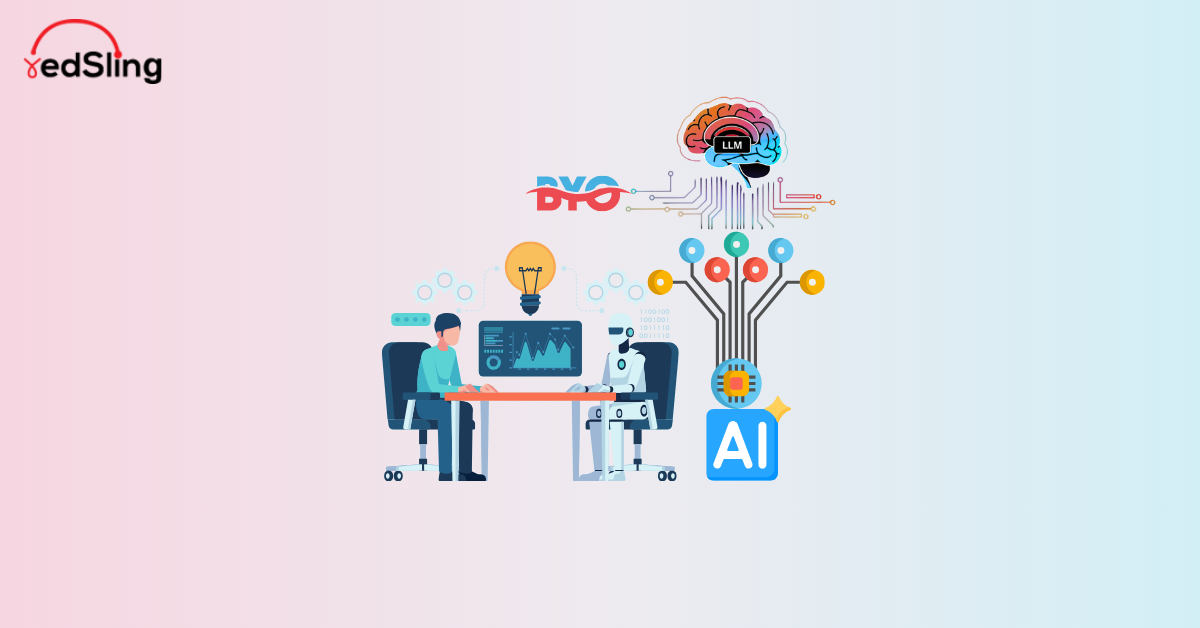
The Rise of AI as an Enterprise Architectural Layer
Enterprises are rapidly moving beyond AI experimentation into full-scale adoption, where large language models are embedded directly into core business applications, workflows, and decision systems. What began as copilots and conversational interfaces is now evolving into something far more fundamental: AI is becoming an architectural layer inside the enterprise stack.
This shift is structural. AI is no longer sitting alongside applications as an external capability, it is increasingly shaping how applications behave, decide, and execute. It influences workflows, automates reasoning, and participates directly in operational decision-making.
As this transformation accelerates, CIOs, CTOs, and Enterprise Architects are converging on a powerful idea, Bring Your Own LLM (BYO LLM). It promises flexibility in model choice, control over cost, and alignment with governance, security, and compliance requirements.
But beneath the surface, a more important architectural truth is emerging: BYO LLM only delivers true enterprise value when the execution layer is no longer controlled by a platform runtime.
In other words, BYO LLM and platform dependency are structurally in tension.
The Illusion of Flexibility in AI-Enabled Platforms
Most enterprise AI offerings now position themselves as flexible, AI-enabled environments. They offer model switching, prompt orchestration, token tracking, and integrations with multiple LLM providers. On the surface, this appears to solve the enterprise need for optionality.
However, the execution model remains largely unchanged. Applications still run inside a controlled runtime. AI calls are mediated through that runtime. Data flows through predefined system boundaries. Governance, observability, and scaling are all interpreted through platform-defined controls.
So, while enterprises may choose which model to use, they do not fully control how intelligence is executed within their applications.
This creates a subtle but critical gap between model flexibility and execution sovereignty.
BYO LLM as an Architectural Sovereignty Decision
One of the most important misunderstandings in enterprise AI strategy is treating BYO LLM as a configuration capability. In reality, it is an architectural sovereignty decision that defines where control actually sits in the system.
At its core, BYO LLM means the enterprise selects the model best suited for each workload, determines where it runs, whether cloud, private infrastructure, sovereign environments, or edge systems and governs how data is processed and consumed within AI-driven workflows.
However, these principles only hold if the application layer does not reintroduce dependency above them. The moment AI is orchestrated through a platform runtime, BYO LLM becomes conditional rather than absolute. It becomes “bring your own model, within predefined execution boundaries.”
And those boundaries are where control subtly shifts away from the enterprise.
The Hidden Constraint: The Runtime as the Real Control Plane
The real limitation of most AI-enabled platforms is not model access. It is runtime control.
Even when external models are integrated, they are still invoked within a controlled execution environment. AI requests pass through platform orchestration layers. Data handling is governed by platform policies. Observability is restricted to platform-defined dashboards. Deployment flexibility is tied to the underlying runtime.
In effect, the platform becomes the control plane for intelligence execution.
This leads to a structural imbalance: enterprises may choose the intelligence provider, but they do not fully control how that intelligence is executed inside their systems. As AI becomes embedded in mission-critical workflows, this distinction moves from theoretical to operational.
The first wave of enterprise AI was assistive with capability around summarisation, copilots, and augmentation. The next wave is operational and decision-centric. AI is now influencing underwriting decisions, fraud detection, supply chain optimisation, customer journeys, and even software delivery pipelines.
At this stage, three forces converge:
- Governance requirements intensify as AI moves into regulated, decision-critical workflows and demands full auditability and control.
- Cost per inference becomes a financial control issue, requiring transparent, real-time visibility across models, teams, and workloads.
- Latency becomes an operational risk, as AI-driven decisions move from assistive to real-time execution inside business-critical systems.
Traditional platform approaches attempt to manage these pressures through layered controls inside a central runtime. But this often introduces abstraction rather than removing complexity, and can slow down both governance and execution.
The Platformless Advantage in redSling
A platformless architecture removes the runtime dependency entirely. Instead of applications being executed inside a vendor-controlled environment, they are generated as self-contained, portable artefacts and deployed directly into infrastructure the enterprise already owns — cloud, private cloud, sovereign environments, or edge systems.
In this model, AI is not “plugged into” a platform layer. It becomes part of the application itself. That shift has direct consequences for how enterprises design, govern, and scale AI systems.
This is where redSling’s approach becomes structurally different. Instead of embedding AI inside a platform runtime, redSling enables applications to be deployed as independent, portable units with AI capabilities built directly into the application layer. This allows enterprises to bring any LLM whether commercial, open-source, or private and connect it natively without being constrained by a central execution environment.
In practical terms, this enables a different operating model for enterprise AI:
-
- AI execution is native to the application, not mediated by a platform layer
- LLM choice becomes fully decoupled from deployment and infrastructure
- Governance is enforced at the application and enterprise level, not the platform boundary
- AI usage and token consumption can be monitored in real time across teams and workloads
- Deployment remains fully portable across cloud, on-prem, and sovereign environments
The result is not just flexibility in model choice but it is architectural ownership of intelligence itself.
The CIO Reality: Removing Structural Trade-Offs
For CIOs and enterprise leaders, AI introduces a familiar tension. Innovation teams want rapid access to the latest models. Security teams require strict control over data and compliance. Finance teams demand predictable AI costs. Architecture teams need portability, resilience, and long-term independence.
Traditional platforms attempt to reconcile these requirements within a single controlled execution environment. But that environment itself becomes the constraint, especially as AI becomes mission-critical.
A platformless approach reframes the problem entirely. Instead of balancing competing priorities within constraints, it removes the dependency that creates those constraints in the first place. Control and innovation are no longer opposing forces; they are outcomes of the same architectural decision.
The Structural Shift in Enterprise Architecture
Every major architectural shift in enterprise technology has followed a consistent pattern: control moves closer to the enterprise, dependency on centralised platforms reduces over time, and execution becomes more distributed and portable.
Cloud decoupled infrastructure from data centres. Containers decoupled applications from infrastructure. Microservices decoupled systems from monoliths. Now AI is driving the next decoupling, the separation of intelligence from platform-controlled execution. BYO LLM is part of this evolution. But it only delivers its full promise when the architecture does not reintroduce centralised control at another layer.
Otherwise, enterprises risk repeating a familiar pattern: new flexibility at the model layer, offset by new dependency at the execution layer.
The conversation around BYO LLM is still focused on the wrong abstraction. The real question is no longer: Which LLM should we use? It becomes: Who controls the layer that connects intelligence to the application?
Because that layer ultimately determines whether AI is a flexible enterprise capability, or a new form of embedded lock-in.
Who Owns Your Intelligence Layer?
The next decade of enterprise architecture will not be defined by which models enterprises adopt, but by where intelligence is executed and controlled. Platforms will continue to evolve. Models will continue to improve. But the structural question will remain the same:
Is AI something you consume through a platform, or something you own as part of your architecture?
This is where platformless approaches such as redSling signal a shift. By removing the runtime dependency entirely and enabling applications to be deployed as independent, portable units, enterprises regain control over AI execution, governance, and cost; while retaining full freedom to bring any LLM.
Not AI inside a platform. But AI as part of your enterprise architecture, fully governed, portable, and fully under your control.