
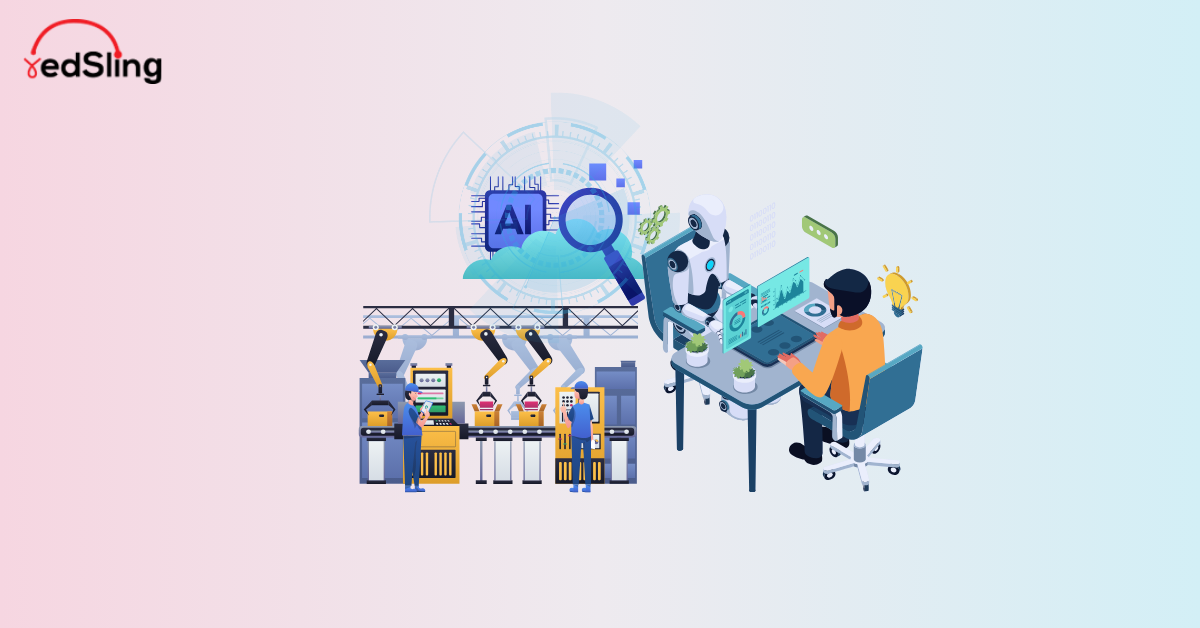
The first wave of enterprise AI worked mostly on information. It generated content, analysed documents and helped people make decisions faster. A second wave is now arriving, and it is more consequential, because it asks what happens when AI moves beyond interpreting the world and begins to influence how the physical world operates. Think of a factory that anticipates changes in production demand, an airport that responds to passenger volumes and weather, or a data centre that continuously tunes its cooling within tight thermal limits. Different settings, but one shared feature: intelligence is connected to physical operations, and the decisions have real consequences.
This is the domain of Physical AI. In this article we look at what it is, why so many projects stall before they reach production, and why the answer lies less in the model than in the architecture around it. We then show how redSling fits, using the redSling and Jetron AI-driven HVAC solution as a worked example.
Physical AI has now moved quickly onto the mainstream enterprise agenda. Gartner named it a Top Strategic Technology Trend for 2026 and ties adoption to new skills spanning IT, operations and engineering, while Forrester argues that mobile robots, collaborative robots and inspection systems, more than humanoids, make the strongest commercial case, and that the technology touches safety, regulation, workforce planning and capital spending. For technology leaders, the useful reading is that growth in Physical AI is steep, adoption will be uneven, and a large share of the spend will go to the integration layer that connects intelligence to operations. That observation leads to the question of what Physical AI is, and what it needs.
What Physical AI actually is
It is wider than robotics
Physical AI describes AI-enabled systems that perceive conditions in the physical world, interpret them, make decisions, and support or execute actions that change their surroundings. The category includes robots, autonomous vehicles, intelligent industrial equipment and smart infrastructure. A chilled-water plant, a production hall or an airport terminal is a physical system whose behaviour affects cost, comfort, quality and resilience, and when AI is connected to the systems that sense and regulate it, the same definition applies.
That is why heating, ventilation and air conditioning makes such a good example. An HVAC system is not simply a set of machines responding to a temperature setting. It is a dynamic
physical system, shaped by weather, humidity, occupancy, equipment behaviour, building design and changing operational demand, and its control decisions affect energy consumption, thermal comfort, equipment life and operating cost. Applying AI here means connecting intelligence to physical behaviour and measurable outcomes, and that is where Physical AI becomes commercially meaningful. The value is not in the sophistication of the algorithm alone. It is in the ability to improve how the physical system operates
Autonomy is a ladder, not a switch
The most useful distinction for enterprise buyers is the degree of autonomy, which is better thought of as a ladder than a switch. At the bottom, AI provides visibility: it collects and visualises operational data, perhaps with three-dimensional views of assets, while humans decide and act. One step up, AI becomes advisory, forecasting and recommending setpoints or schedules while an operator approves every action. At the supervised level, the system proposes actions and executes approved classes of action, with operators able to override and limits enforced.
Higher still is bounded autonomous control, where the AI optimises in a closed loop within validated limits, supported by command validation, fault handling, operator override and a full audit trail. At the top, AI coordinates multiple systems or sites toward joint objectives under policy, with a human on the loop rather than in it. Most credible deployments climb this ladder one rung at a time, because each rung needs different guardrails, different evidence and a different level of operator trust.
Three principles follow from this. Intelligence can be central, but control stays local, so deterministic control and protective functions remain in controllers and safety systems. AI proposes and the system disposes, meaning every AI output reaches equipment through a validation layer that enforces operating limits. And authority is explicit: which decisions AI may make, which need approval, and what happens when the AI service is unavailable are all designed, written down and auditable. Not every process should be automated, and the aim is not to put a general-purpose model in charge of everything. It is to apply intelligence where it creates measurable value, inside clearly defined boundaries.
Why Physical AI pilots stall before production
A model connected to a sensor is a demonstration, whereas a production system has to cope with imperfect data, legacy protocols, safety constraints, cyber risk and the realities of where it has to run. Six obstacles recur, and it is worth taking them in turn, because together they explain why so many promising pilots never scale.
The first is the divide between IT and operational technology. Enterprise applications, analytics and AI live in IT, while sensors, programmable logic controllers, building management systems and supervisory control live in OT. They have different owners, protocols and priorities. Gartner’s Hype Cycle for Physical AI, points to the lack of a unified foundation between legacy infrastructure and new software as a central obstacle.
The second obstacle follows directly: data. Operational data is often incomplete, inconsistent or missing the context that explains it, and a reading without equipment, schedule and load context is hard to act on safely. Even good data runs into the third obstacle, which is control and safety. Decisions must respect strict operating limits, and existing controllers and safety systems should keep enforcing protective functions. An AI that cannot be bounded cannot be deployed.
Connecting operational assets also creates the fourth obstacle, cyber exposure. Newly connected OT enlarges the attack surface, and an incident can affect the availability and behaviour of physical assets, not only data. The fifth is deployment. Sites may be on-premises, at the edge, air-gapped or on restricted industrial networks, and a solution that needs a vendor’s cloud or runtime simply cannot follow. Finally, there is the burden of integration. Bespoke integration is slow and expensive, every site differs, and industry coverage points to multi-year integration projects as a drag on the economics.
Notice what these six have in common. None of them is a model problem. They are application-architecture problems, and in practice the model is rarely the hard part. The hard part is the dependable software between the model and the machine.
A reference architecture for production Physical AI
Three tiers: intelligence, validation and control
The pattern that lets AI act on physical systems without compromising safety separates intelligence, validation and control into distinct tiers. The first tier is the brain: forecasting, optimisation and learning on weather, history, schedules and live data, using a model of the customer’s choice. The second is the nerve, a validation and orchestration layer at the edge that translates strategy into validated commands, enforces limits, sequences actions, manages faults and fails over. It is the bridge between IT and OT. The third tier is the hands: deterministic control and equipment, with PLC and SCADA execution, local safety and precise control of chillers, pumps, valves, robots and machines.
A handful of design rules keep this pattern honest. Never let a model write directly to equipment. Plan for the AI being unavailable, so that controllers keep local control and the system degrades to conventional operation. Keep the loop closed and observable, so models learn from outcomes and operators see what the system did and why. Make the operator a participant, because override controls and clear explanations build the trust that moves a site up the autonomy ladder. And treat deployment as part of the design, since the same application should be able to run in the cloud, on-premises, at the edge or air-gapped.
The application layer that ties them together
Spanning all three tiers is the application layer, and this is the tier most often missing. It is the software that unifies device communication, data, workflows, operator interfaces and overrides, integration with enterprise systems, governance, logging and deployment. It is where most enterprise effort now concentrates, and where most lock-in risk sits too. Which brings us to the question of how to build it.
What redSling brings to Physical AI
Platformless architecture
An application built in redSling is exported as a self-contained, OCI-compliant Docker artefact and deployed in whichever enterprise environment suits it, with no proprietary redSling runtime. That separates the place where an application is designed and governed from the place where it runs, so it can follow the infrastructure and sovereignty needs of each site, whether public or private cloud, on-premises, edge, air-gapped or industrial 5G.
Agentic AI-assisted no-code development
Speed and repeatability matter because every site differs. redSling combines a visual no-code environment, including UI and Logic Builders, with an Agentic AI Dev Squad that assists across requirements, interface design, data modelling, workflow logic, documentation, testing and deployment preparation. The visual environment provides structure, and human oversight remains in place throughout the lifecycle. For operational applications, that means WebSocket device connectivity, REST integration with PLC, SCADA, building management and enterprise systems, and three-dimensional visualisation of robots, sensors and environments with live updates.
AI and software on your terms
Physical AI cannot be one-size-fits-all, so redSling lets customers bring their own model, including private and on-premises models, and keep data privacy and vendor flexibility under their own governance. Customers host and control production on a predictable annual per-app licence. Project Settings adds audit logs that are pre-structured to align with seven compliance frameworks: SOC 2 Type II, ISO 27001, GDPR, HIPAA, SOX, RBI/APRA and FedRAMP Foundation Level. That is alignment, not certification, and customers remain responsible for their own compliance programmes
What redSling does not do
It is worth being plain about the limits. redSling is an application layer. It does not replace PLCs, safety systems or real-time control, and the exported container application image artefact still depends on whatever external services the application uses. Its role is to unify data, models, workflows, interfaces and audit around those systems. That clarity is also what makes the worked example below easy to follow.
A worked example: redSling and Jetron AI-driven HVAC Solution
Why HVAC is a strong starting point
HVAC is found across factories, airports, commercial buildings and data centres. The physical system is established, energy use is measurable, and performance can be assessed against a baseline, which makes it an ideal place to prove Physical AI. Conventional control strategies rely on configured setpoints, schedules and feedback loops. These remain essential, but on their own they can struggle to anticipate complex changes in demand. AI extends that capability by forecasting changing conditions and optimising operating decisions rather than reacting after the fact.
The redSling and Jetron solution pairs Jetron’s control intelligence with redSling’s unifying application layer. Jetron’s three-layer control architecture is patented and designed to address the gap between intelligent decision-making and physical equipment control.
How the closed loop works
The first layer is the AI model, the brain. It processes weather data, historical patterns and schedules, updates control policies every few minutes, and keeps learning across cycles. The second is edge middleware, the nerve. It validates every command before it reaches equipment, sequences actions, manages faults and fails over autonomously, which addresses the risk of erroneous AI-generated actions. The third is PLC execution, the hands, which applies commands to chillers, pumps and valves in milliseconds, with local safety and status feedback.
redSling is the unifying layer across all three. Information flows both ways between the AI model, redSling, the PLC and SCADA systems, and the equipment, and redSling brings IoT devices, AI models, workflows and user interfaces together into a single deployable application, built without traditional coding. Equipment status flows up, policies are refined, commands are validated and executed locally, and the outcomes feedback so the policies improve with each cycle. Operators can override at any point. Most AI HVAC offerings remain advisory, recommending actions for a human to take. This design targets bounded, closed-loop control while keeping established controllers and local safety in place.
One AI foundation, different objectives
The underlying intelligence can be reused, but the operational objective has to stay specific to the environment. In a factory, HVAC is a process input rather than a comfort system, so the AI protects production stability, adapts to machine heat loads, pre-conditions spaces before high-load periods and flags thermal anomalies early. In a data centre, uptime and thermal precision come first, so the AI predicts hotspots, supports autonomous failover across the cooling chain and works to improve power usage effectiveness. In an airport, occupancy swings from delays and seasons, so the AI manages airflow by zone, pre-conditions terminals from flight schedules and keeps ventilation within indoor air quality standards while saving energy during quiet periods.
Jetron and redSling can report 15 to 25 per cent committed energy savings, a 23.6 per cent peak performance gain, more than 97 per cent autonomous operation and 99.5 per cent reliability, with a return on investment in 12 to 24 months. In addition, the solution supports non-disruptive deployment and compatibility with around 90 per cent of mainstream HVAC equipment.
The Path Ahead
Looking ahead, Physical AI is likely to shift from optimising single assets to coordinating whole operating environments. In buildings, that may mean aligning HVAC with occupancy, energy tariffs, on-site generation and storage. In factories, it may mean matching environmental conditions to production schedules, and across infrastructure it may mean balancing efficiency, resilience and service quality across systems. Digital twins and simulation will play a growing role in validating behaviour before it touches the physical world, which is why three-dimensional visualisation belongs in the application layer.
Physical AI extends enterprise AI from information into the systems organisations depend on. That makes IT-OT integration a strategic capability, and it elevates application architecture, deployment freedom and governance from implementation details to determinants of success. The organisations that progress most effectively will treat Physical AI as an operational transformation, not a technology acquisition.
redSling’s platformless, agentic no-code architecture is designed for that tier, and the redSling and Jetron AI-driven HVAC solution shows what it looks like in practice: predictive intelligence, validated edge control and deterministic execution, unified in one application that runs wherever the site requires. The future is not simply AI that understands more. It is AI that helps the systems around us operate more intelligently.
If you would like to see how this works for your estate, get in touch with the redSling team.
redSling: No Code. Platformless Power. Pure Intelligence.